At its core, The Patient Work is a phenology journal: a record of changes in weather, plants, animals, insects, and the landscape throughout the year. I happened upon this practice by returning to the same places again and again. Some places are visited annually, like Big Bear; some seasonally, like Tin Mine Canyon; and one almost daily: the bend in the Santa Ana River beside the Green River Golf Course.
Over time, I have come to know this small stretch of the watershed intimately. I photograph it, write about it, and notice when something has arrived, disappeared, bloomed, dried, nested, emerged, or gone quiet. It is not an extraordinary-looking section of the river, but it supports a surprising variety of life because it lies near the threshold between riparian and chaparral environments. Within a five-minute walk, you might encounter a thistledown velvet ant moving through dry upland vegetation, desert broom growing beside the trail, or a double-crested cormorant sunning its wings near arroyo and sandbar willows along the river.
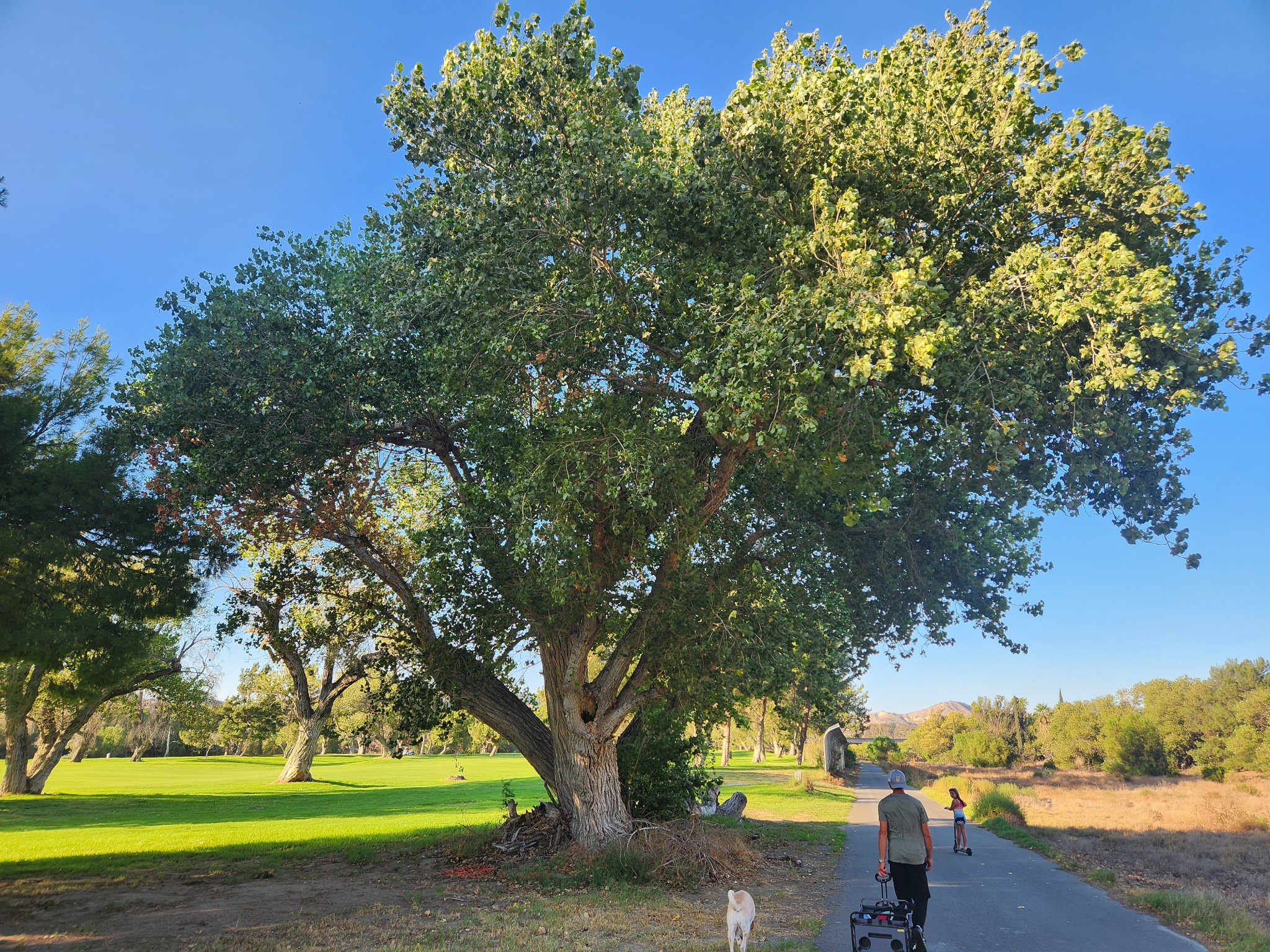
The defining trees of this bend are the Fremont cottonwoods (Populus fremontii). Because they are deciduous, their leaves make seasonal change especially visible and especially rewarding to document. Their emergence, growth, fading, and eventual fall provide a calendar written across the canopy.
We begin with the transition from deep summer to fall. By early September, prolonged heat and aridity have transformed much of the surrounding landscape into a mosaic of tan grasses and summer-weary shrubs. Deep-green toyons, sugar bushes, and coast live oaks occasionally interrupt the brown mélange, but the season is largely defined by a subdued palette.
Then the eye reaches the center of the valley.
There, the Santa Ana River winds through a nearly continuous stand of Fremont cottonwoods. Even when the water itself is hidden, the trees reveal its course. Their green canopies stand in sharp contrast to the dry slopes around them, tracing a living line through the watershed.
 © Lindsey Thome
Fremont cottonwoods are common riparian trees throughout the Southwest. They grow beside rivers, streams, washes, and other places where their roots can reach reliable water. Fast-growing trees, they may reach approximately 50 to 100 feet in height, with broad, spreading crowns. Some grow from a single trunk; others divide into several substantial boughs. Younger trees generally have smoother bark, while mature trees develop deeply furrowed bark and increasingly complex trunk structures. Broken limbs, hollows, peeling bark, and cavities can provide habitat for insects, spiders, bees, birds, reptiles, and small mammals.
Their glossy, heart-shaped leaves remain bright green through much of the growing season before turning yellow or pale orange and falling. Fremont cottonwoods are dioecious: male and female flowers usually occur on separate trees. Both produce flowers in hanging catkins, while female trees later release seeds attached to cottony fibers that drift on the wind.
Fremont cottonwoods are so closely associated with water that a continuous stand practically announces the location of a stream or river. They make otherwise hidden water visible. They shade the banks, shelter other lives, drop leaves and wood into the decomposing world below, and preserve evidence of drought, wind, irrigation, injury, and age in their bodies.
Until now, I have mostly written about these trees as a group. But I do not experience them that way. Certain cottonwoods have become landmarks in my walks, each recognizable by its location, architecture, inhabitants, and history.
For the first installment of The Cottonwood Chronicles, I selected five trees: the Greeter, the Commons, Ole Miss, the Sentinel, and the Newcomer. I will revisit them at each solstice and equinox over the coming year, for five issues in all, from this fall equinox to the next. Each tells a different story about cottonwoods along the Santa Ana River.
| Issue | Moment | What I will be watching |
|---|---|---|
| 1 | Fall Equinox 2026 | The baseline: leaf color, canopy, galls, deadwood |
| 2 | Winter Solstice, Dec 2026 | Leaf drop; what bare crowns, deadwood, and mistletoe reveal |
| 3 | Spring Equinox, Mar 2027 | Catkins, sex, and leaf-out |
| 4 | Summer Solstice, Jun 2027 | Full canopy, galls, and the fallen log’s decay |
| 5 | Fall Equinox 2027 | A return to the baseline: one full turn of the calendar |
CW01
The Greeter
- Form
- Single, straight trunk
- Circumference
- 149 inches
- Estimated height
- ≈55 feet
- Water relationship
- Irrigated field
- Notable inhabitants
- Small birds and ants
- Fall baseline
- Under 10% yellow; no leaf galls observed
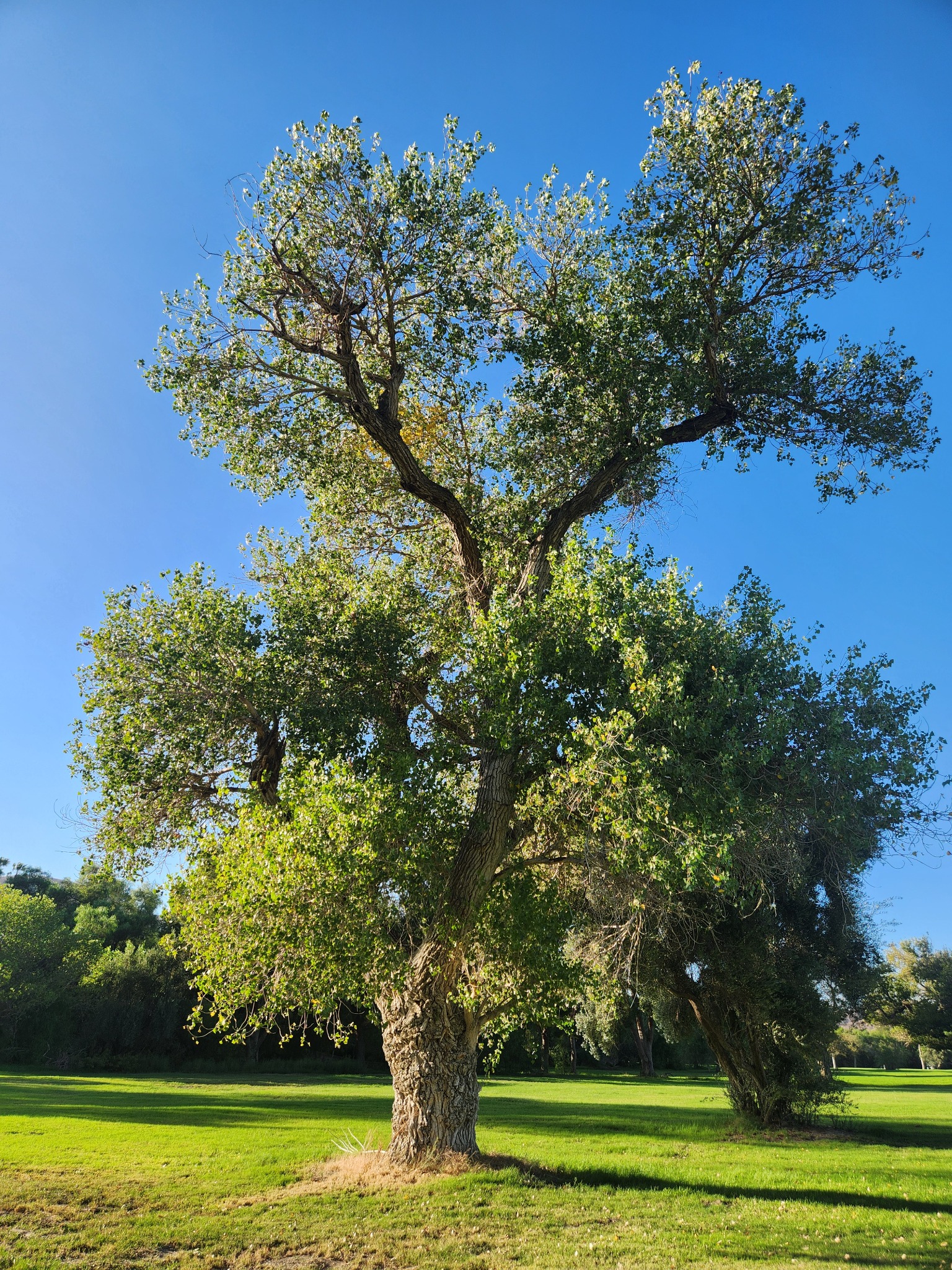
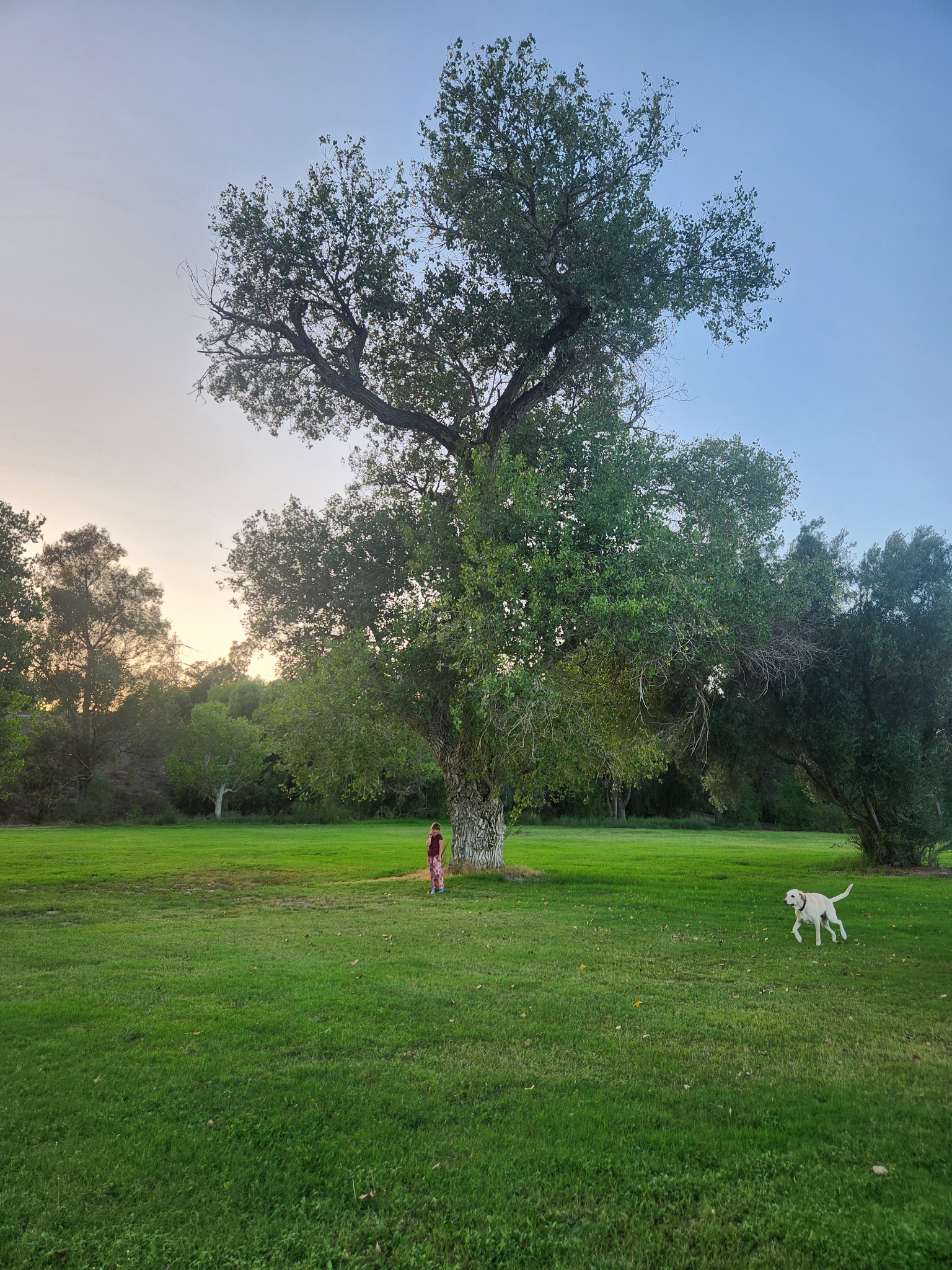
Although the Greeter is not the first cottonwood visible upon entering the golf course, she is the stateliest tree in the field beside the parking lot. I usually encounter her in the late afternoon or early evening, facing west, with the setting sun behind her. In that light, her canopy appears illuminated. She provides a lovely welcome to the golf course, and because she is also the most prominent cottonwood visible on the way out, she seems to offer a farewell.
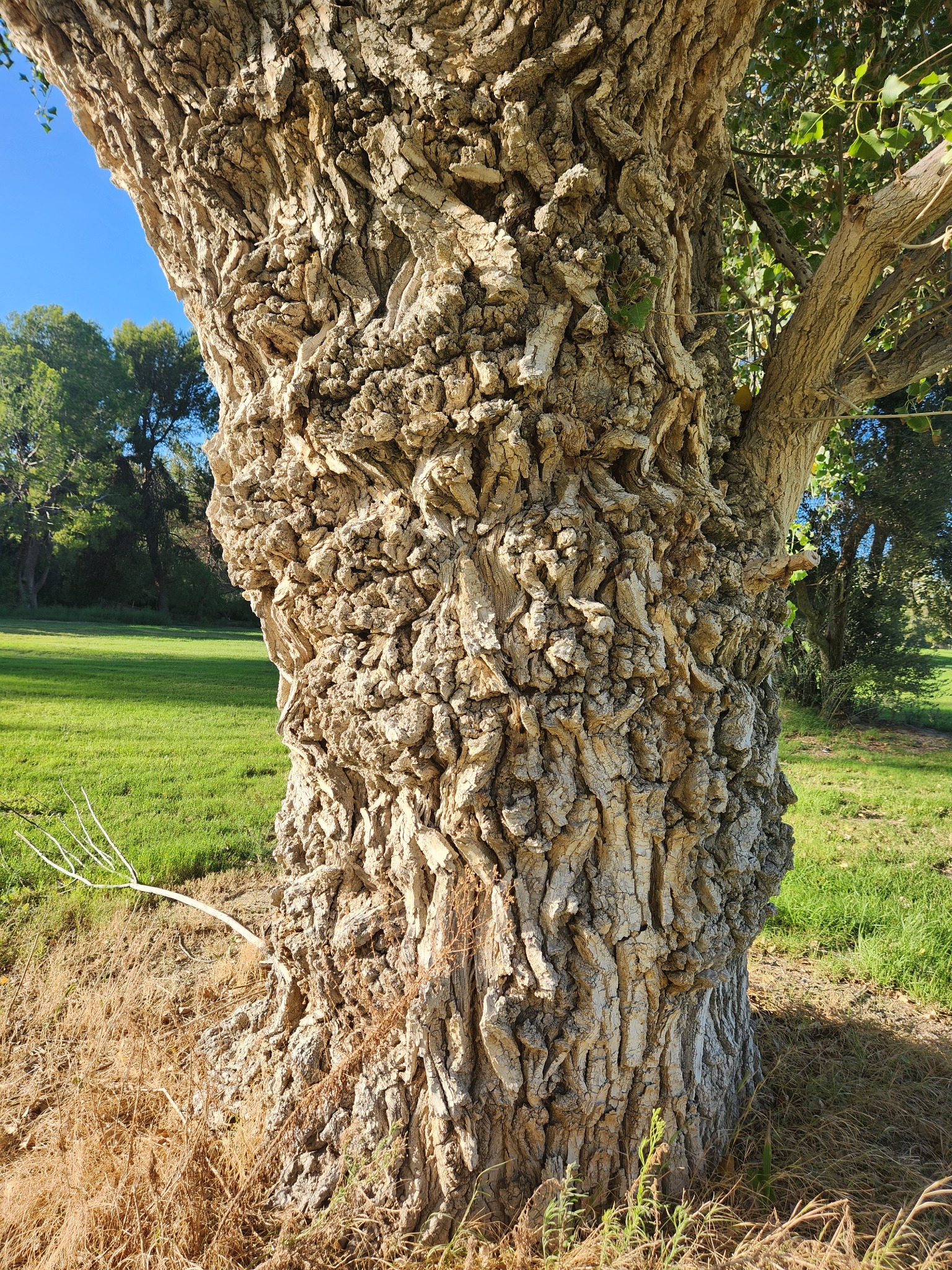
The Greeter’s single, straight, pale-gray trunk rises approximately ten feet before dividing into her first major boughs. Her bark is deeply furrowed, with fissures that bend and twist rather than following a straight course. The canopy is full, with no obvious missing limbs or visible signs of major damage.
I usually associate the Greeter with small birds, but photographs of her bark have revealed another community at a much smaller scale. Ants use the deepest fissures as vertical highways, disappearing into the grooves and emerging farther up the trunk. Her nearest neighbors are a shorter cottonwood and an olive tree. My daughter likes to pretend that the Greeter is my house, the olive tree is her house, and the green field stretching out in front of them is our backyard. It’s a fun way to make a tree feel more familiar.
 © Lindsey Thome
 © Lindsey Thome
The Greeter’s broad crown and deeply furrowed bark make her recognizable at both ends of the walk.
I chose the Greeter because she is one of the largest and most prominent cottonwoods near the parking lot, but also because her single trunk and broad crown make her especially easy to recognize from a distance. She is a landmark at both ends of the walk.
At the fall equinox, most of her canopy remained bright green, with approximately ten percent of her leaves fading to soft yellow. However, she is starting to drop some leaves. When the evening wind moves inland from the Pacific, her leaves flutter and flash in the lowering sun, and the occasional loose leaf shuffles off into the wind before landing in the grass. Soon the grass will be covered in spent leaves, but that’s a story for the winter solstice.
CW02
The Commons
- Form
- Four trunks from a mounded base
- Circumference
- 105 inches, one of four trunks
- Estimated height
- ≈42 feet
- Water relationship
- Consistently irrigated
- Notable inhabitants
- Bees, spiders, fungi, beetles, damselflies, snake
- Fall baseline
- Under 10% yellow; heavy leaf and bark litter at base
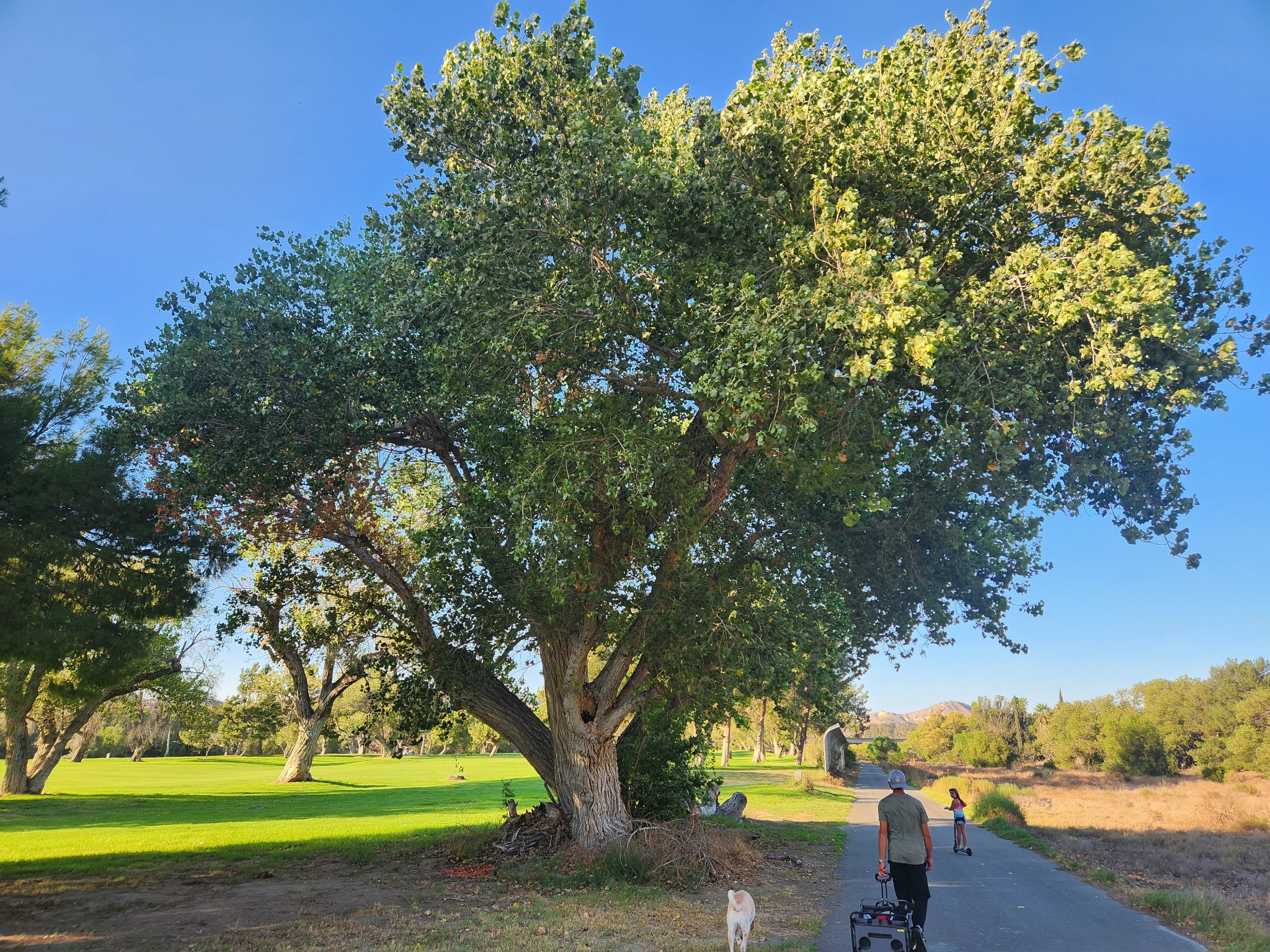
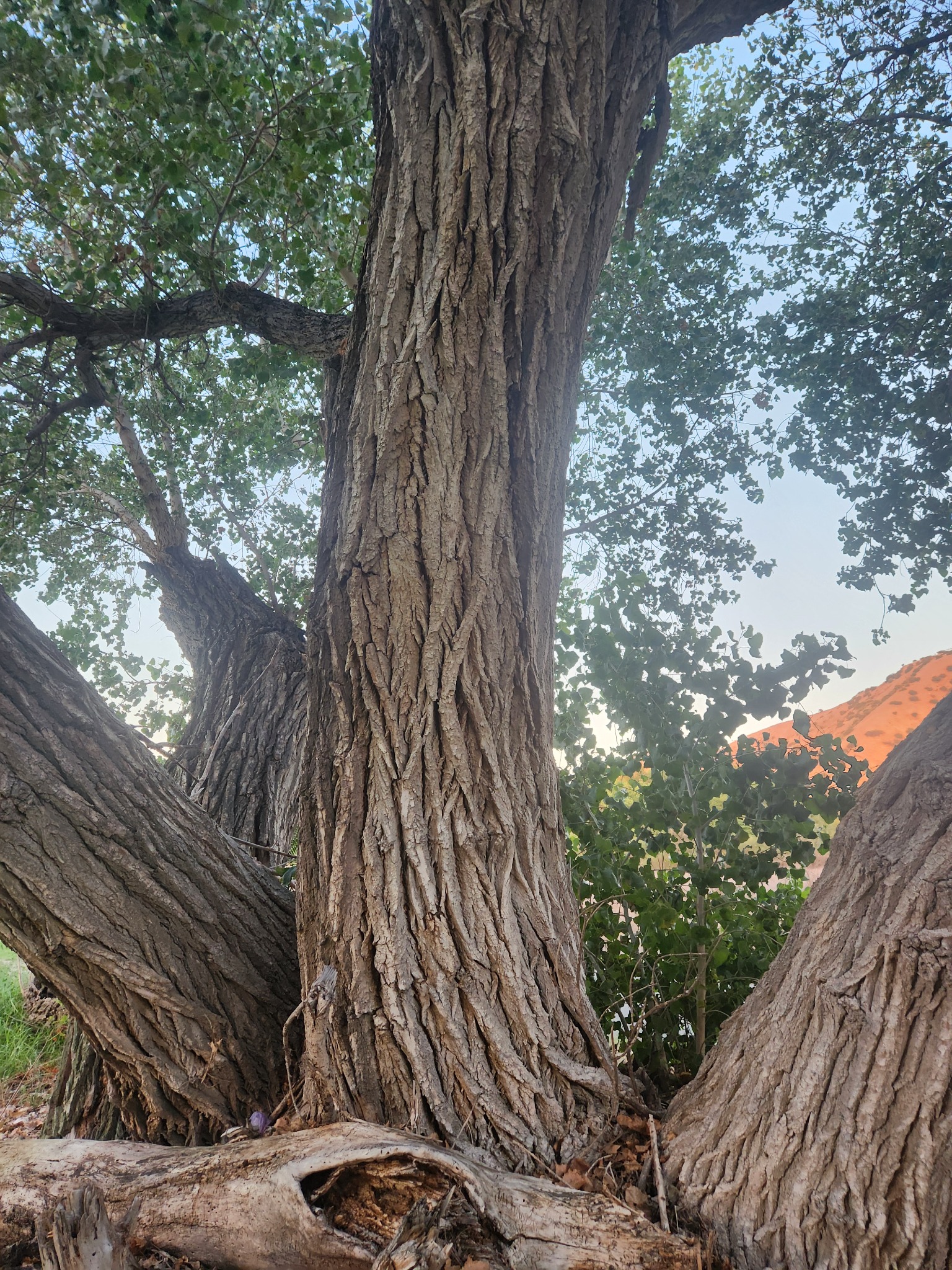
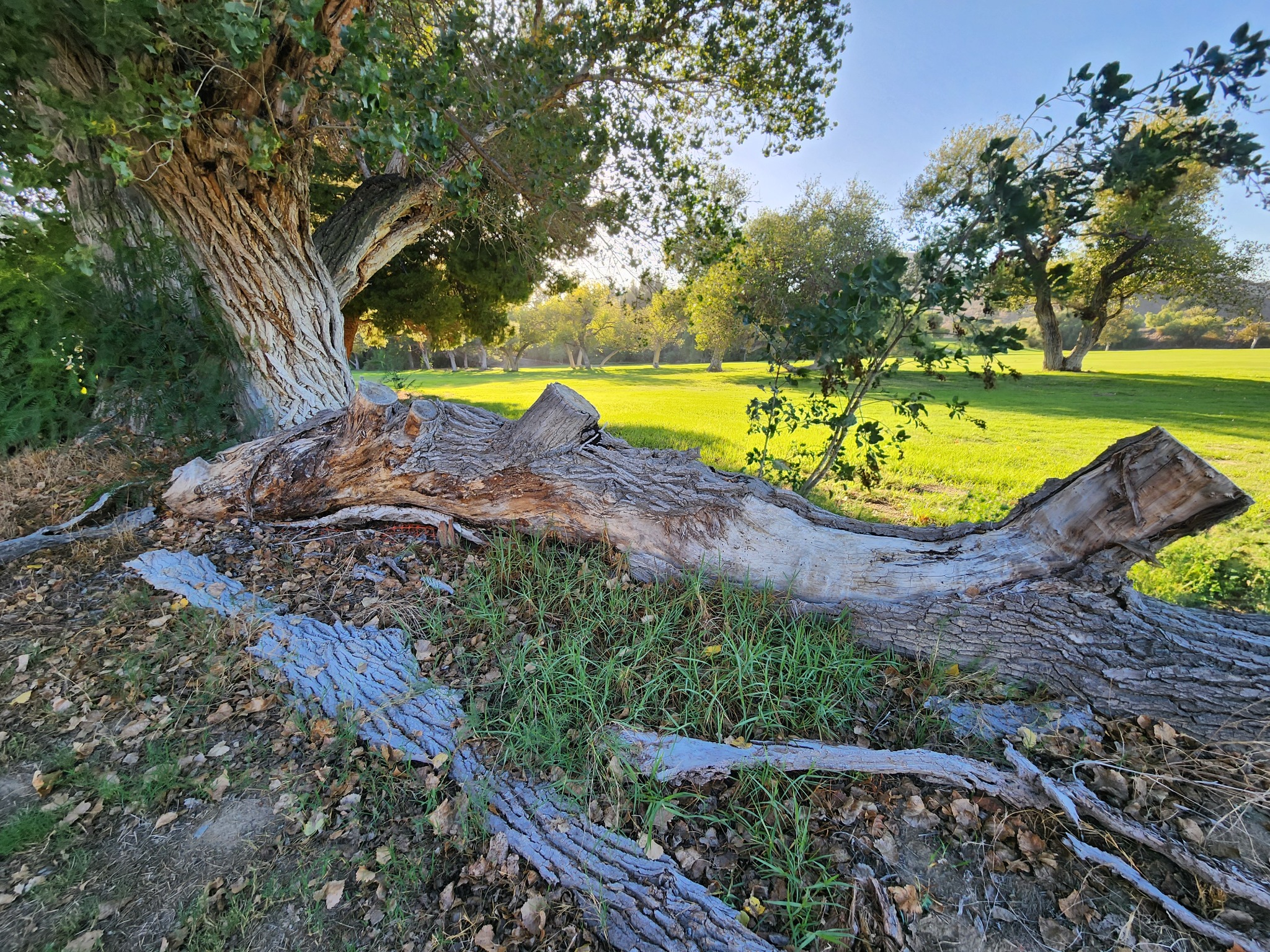
The Commons grows beside a narrow asphalt service road, not far from two large pines. Four substantial trunks emerge from her broad, mounded base, giving her less the appearance of a single individual than a gathering. Beside her lies a fallen cottonwood bough in a moderate state of decomposition. I suspect it fell, or was cut by the golf course; either way, it was never removed and now serves as a magnet for a variety of animals and insects.
I began paying closer attention to this tree because of a funnel weaver living beneath the fallen wood. Throughout the summer, I stopped during my afternoon walks to say hello to the weaver waiting at the mouth of her funnel. Those visits revealed how many other lives were using the same small area. A western black widow built a web nearby and guarded an egg sac. Ants and beetles moved through the bark and leaf litter. Fungi appeared on the fallen bough. Damselflies rested on the grass blades growing from her mounded base. An active honeybee colony occupied a cavity in the living tree’s base, which is also why only one of her four trunks could be measured safely. A small fig tree was even growing in the V where two trunks join. Most recently, a gopher snake appeared at the log.
 © Lindsey Thome
 © Lindsey Thome
Four living trunks rise from the Commons’ mounded base; fallen wood nearby supports a second community.
The name the Commons came from this accumulation of inhabitants. Her living trunks provide shade, perches, hollows, and nesting space. Her fallen wood supports decomposers and detritivores. Bark and leaves collect around her uneven base because a riding mower cannot easily pass beneath her. Behind her, a row of cottonwoods catches errant golf balls before they reach the adjacent field. Even in decline and decay, parts of the tree remain useful.
 © Lindsey Thome
The fallen log near the base of the Commons offers something the other four trees do not: an opportunity to follow decomposition alongside seasonal change. I am especially interested in detritivores and decomposers, so I’ll use this site to also document how bark loosens, fungi spread, cavities deepen, and new inhabitants take possession.
At the fall equinox, most of her canopy remained bright green, with fewer than ten percent of the leaves turning soft yellow. Leaf and bark litter had accumulated around the mounded base and fallen bough. The canopy still belonged largely to summer, while the ground beneath her was already recording what she had begun to release.
CW03
Ole Miss
- Form
- Single trunk; first large bough at about six feet
- Circumference
- 104.5 inches
- Estimated height
- ≈45 feet
- Water relationship
- Golf green sprinklers
- Notable inhabitants
- Mistletoe, western bluebirds, western fence lizards
- Fall baseline
- Under 10% gold; olive mistletoe; dead limb in crown
Ole Miss is the last cottonwood I typically encounter on the manicured portion of the golf course before we amble toward the footbridge beside the railroad tracks.
She is a dangerous beauty.
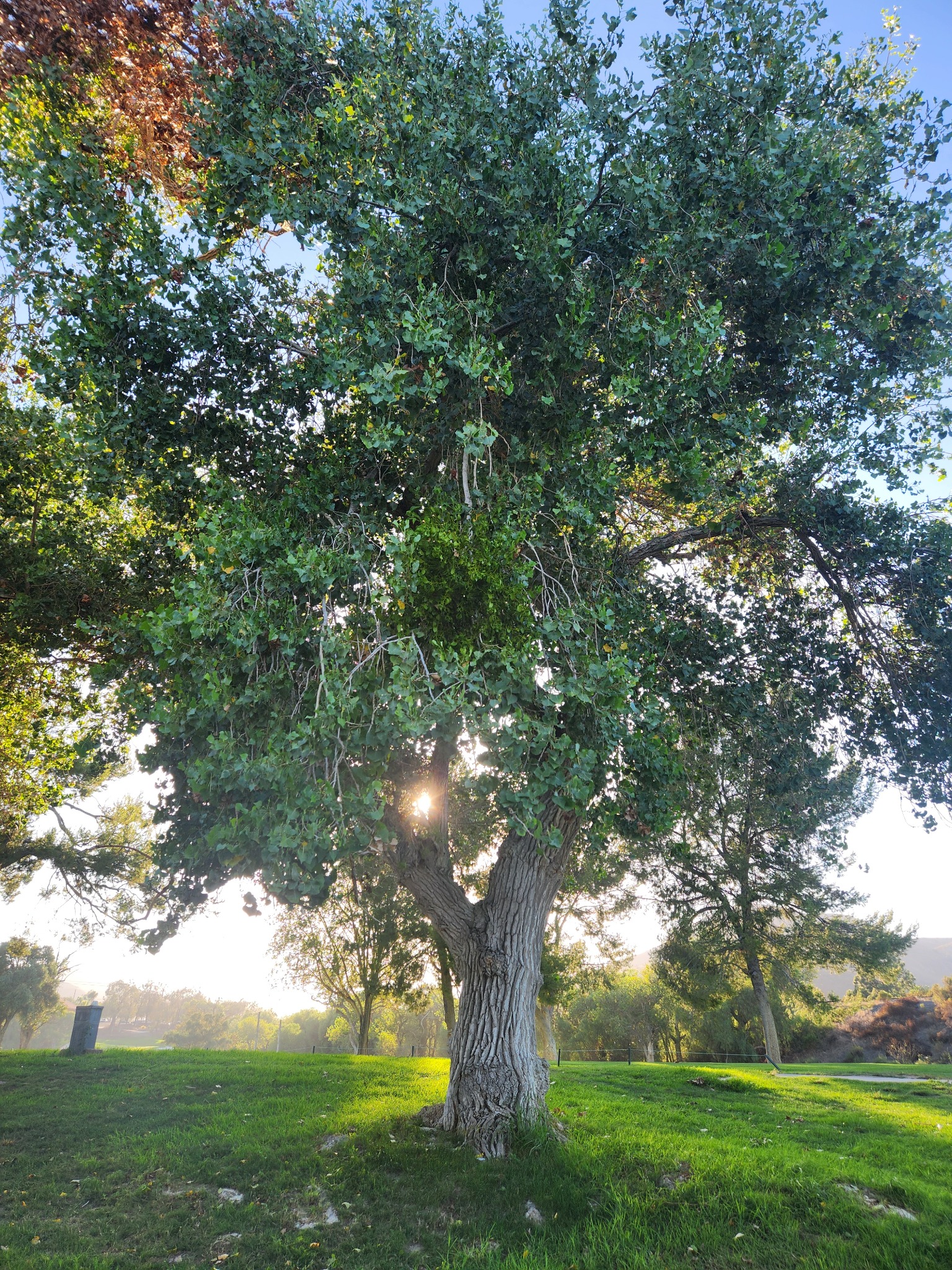
Like the Greeter, Ole Miss stands west of the footpath, placing the setting sun directly behind her during our evening walks. The Greeter’s upper canopy catches the golden light, but Ole Miss has the additional benefit of the broad, rolling golf-course green behind her. With little to obstruct the view, her canopy becomes saturated with the colors of sunset. Pinks, purples, reds, and golds pass through the leaves in the evening.
 © Lindsey Thome
 © Lindsey Thome
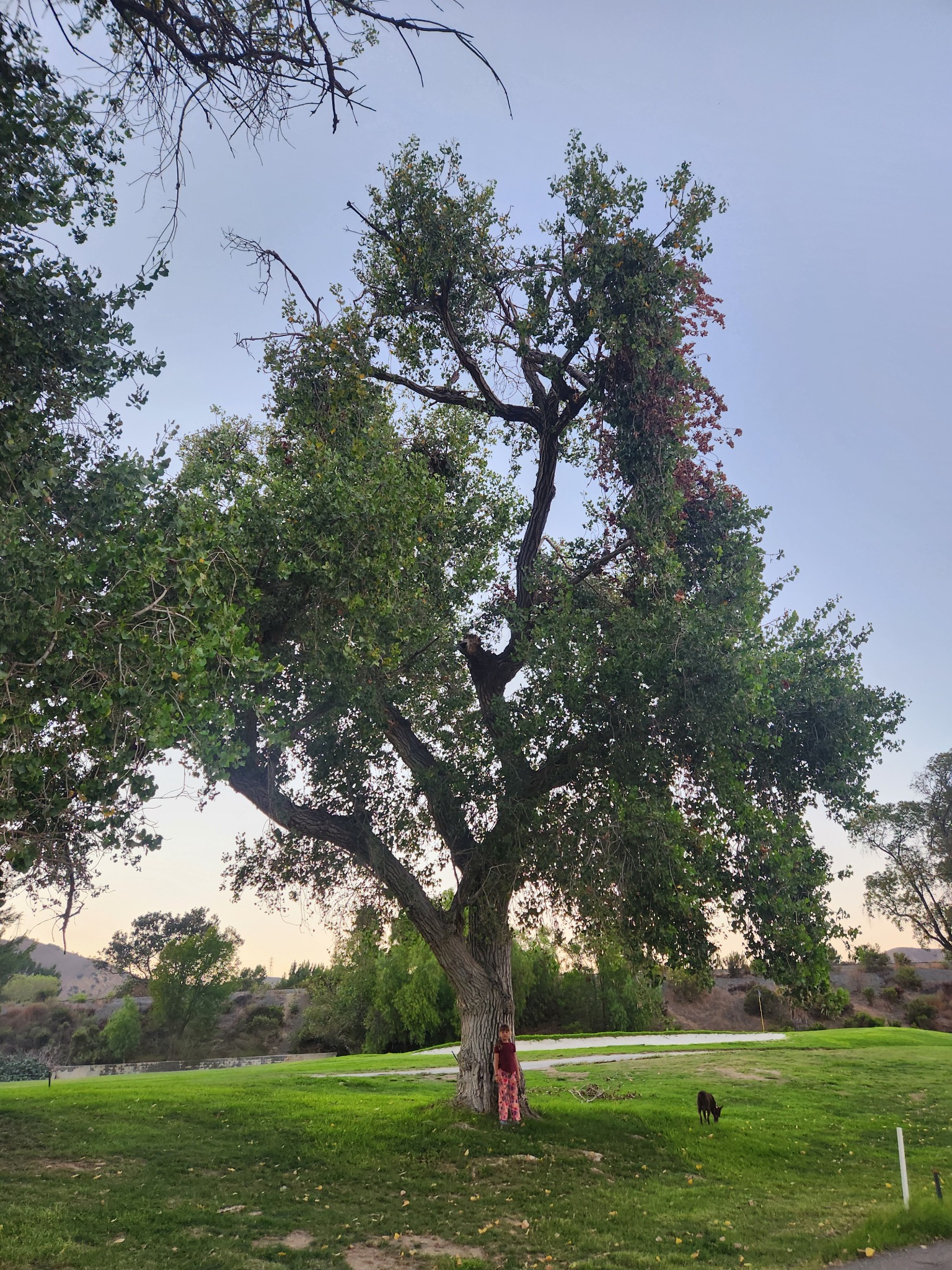
Ole Miss is the only cottonwood in the group where I have observed mistletoe in the canopy.
Ole Miss earned her name because she is the only cottonwood at the golf course where I have observed mistletoe growing in the canopy (Ole Miss, a play on “Miss-letoe”). When family members join me on these walks, including my niece and nephew, I ask them to stand beneath it and look up, then plant a quick kiss on a cheek. It is fun for the children and nostalgic for the adults.
A visit to Ole Miss requires caution; one mustn’t linger under her mistletoe for long. A dead limb remains suspended in her upper canopy, and she has dropped branches before. If we had not named her Ole Miss, we might have called her the Widowmaker.
Her closest neighbor is an even larger cottonwood with its own deadwood and questionable limbs. Together, the two trees form an imperfect barrier between the golf-course green and the service road, helping intercept the occasional shanked golf ball. The barrier is not foolproof, so this section of the walk calls for attention from above and from the fairway.
Ole Miss is also associated with western bluebirds, although smaller birds occasionally visit her canopy. At ground level, my dogs regularly send western fence lizards scrambling up her deeply furrowed trunk. The tree is therefore a meeting place between the highly managed golf course and the less manageable lives that occupy it.
At the fall equinox, Ole Miss retained a full canopy. Most of her leaves remained bright green, with fewer than ten percent turning gold. The mistletoe was also green, but its deeper olive color distinguished it from the lime and yellowing tones of the cottonwood leaves. For now, host and hemiparasite remain visibly entwined: two different greens held in the same autumn canopy. Mistletoe stays green when its host sheds her leaves, so Ole Miss should look quite different by the winter solstice.
CW04
The Sentinel
- Form
- Substantial single trunk
- Circumference
- 163 inches
- Estimated height
- ≈65 feet
- Water relationship
- Possibly groundwater, inferred
- Setting
- Floodplain ridge above the riverbank cottonwoods
- Fall baseline
- Under 10% gold; crown mostly green
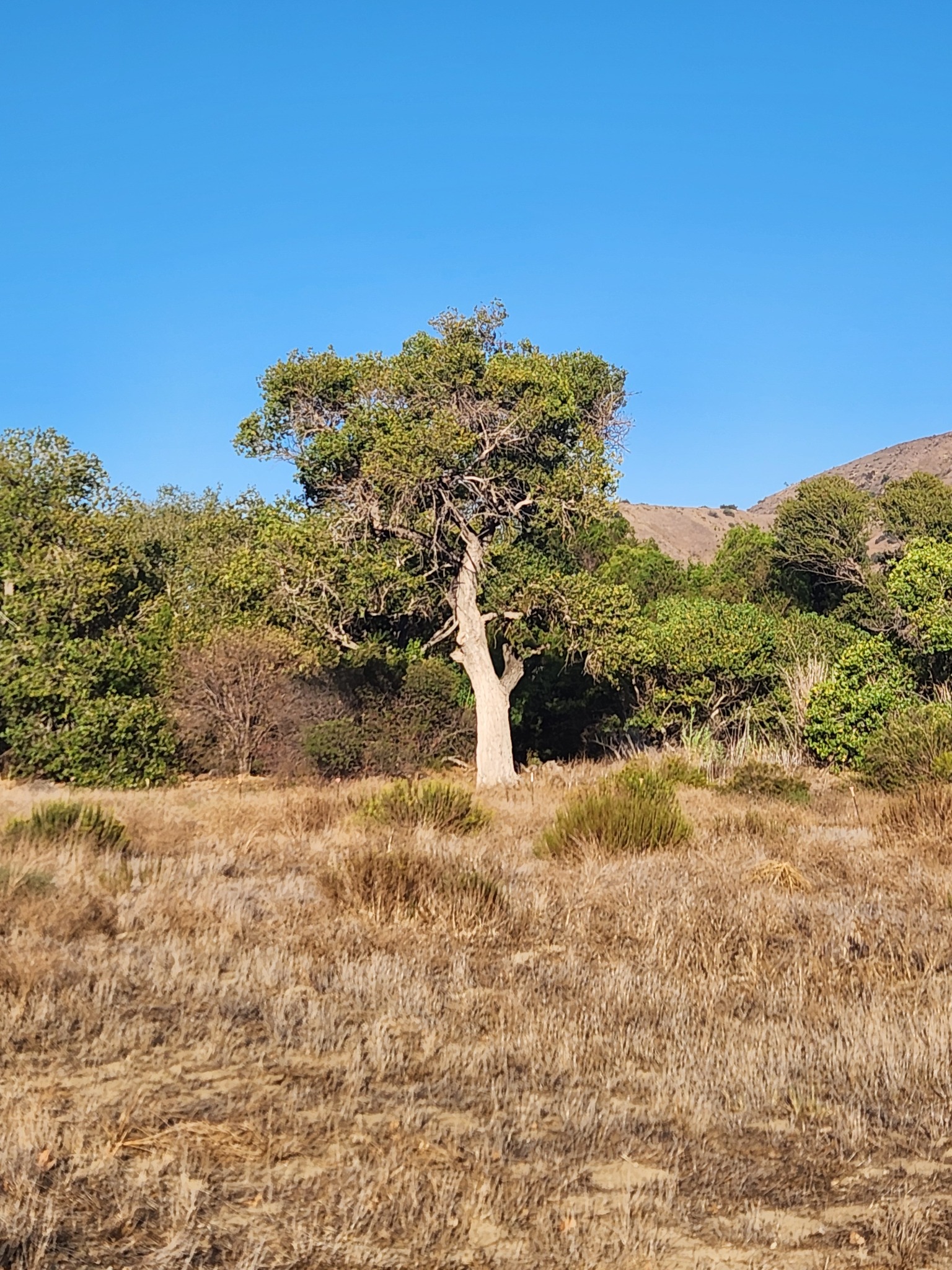
Unlike the Greeter, the Commons, and Ole Miss, the Sentinel does not appear to receive direct irrigation, nor does she grow immediately beside the river. Her water source is therefore less obvious. A golf-course groundskeeper once told me that the groundwater table beneath this area is relatively high, so it is possible that the Sentinel’s roots reach groundwater below the floodplain. For now, that remains my best guess based on her size and persistence.
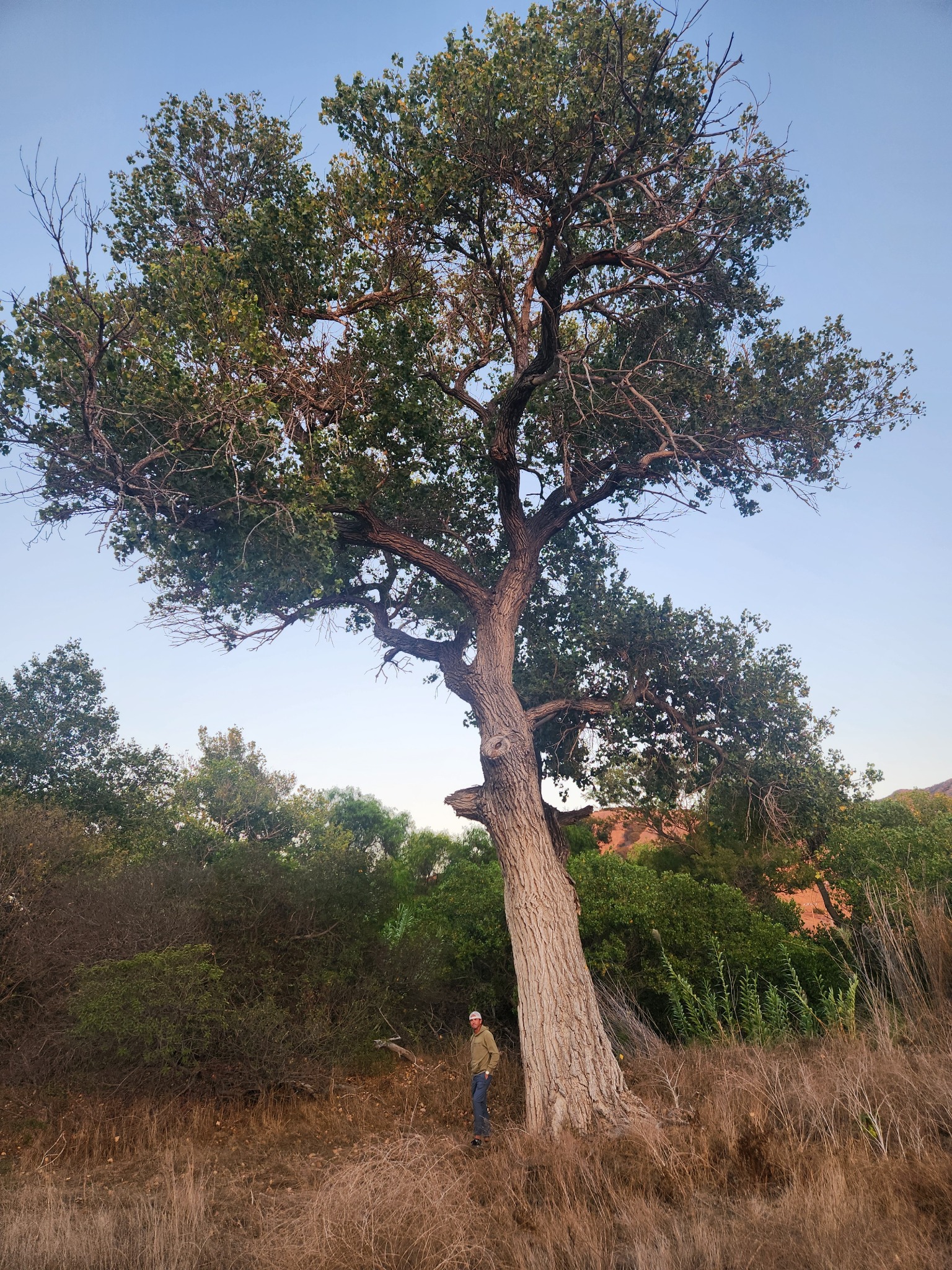
The Sentinel stands at the edge of an open field that functions as part of the river’s floodplain, providing room for water to spread during periods of high flow. Numerous cottonwoods grow along the riverbank behind her, but the Sentinel stands slightly apart and above them. She is not quite on the slope leading to the river and not quite in the open field. Instead, she occupies the top of the ridge, where her substantial single trunk rises above the surrounding vegetation. From the service road, she appears to stand guard over the cottonwoods below. Hence her name.
 © Lindsey Thome
 © Lindsey Thome
The Sentinel’s position above the floodplain makes her visible from afar; her 163-inch trunk is most impressive up close.
Reaching the Sentinel is more difficult than seeing her. The floodplain supports a dense mixture of plants: native telegraph weed and goldfields alongside nonnative thistles, tumbleweed, European grasses, and castor bean. The route also crosses ant mounds, vole and mouse burrows, and the territories of snakes, beetles, and other small residents. My husband, Steven, and I eventually braved the trek so that we could measure her trunk and photograph him beside her for scale.
The Sentinel is impressive from the service road, but I did not understand the immensity of her trunk until I stood beside her. At 163 inches in circumference, she is the largest of the single-trunked cottonwoods in this series. Her estimated height is approximately 65 feet.
I chose the Sentinel because her position and water relationship distinguish her from the other trees. She offers an opportunity to observe a mature cottonwood outside the regularly irrigated portion of the golf course and away from the immediate riverbank. Her survival may reveal something about the less visible water moving beneath this landscape.
At the fall equinox, the Sentinel’s crown remained predominantly green, with fewer than ten percent of her leaves turning golden yellow. From a distance, she still appeared fully clothed in summer.
CW05
The Newcomer
- Form
- Five or more slender trunks
- Circumference
- Not safely measurable
- Estimated height
- ≈35 feet
- Water relationship
- Riverbank
- Notable inhabitants
- Petiole gall aphids, bushtits, goldfinches
- Fall baseline
- Under 10% yellow overall; about 40% at crown; galls widespread
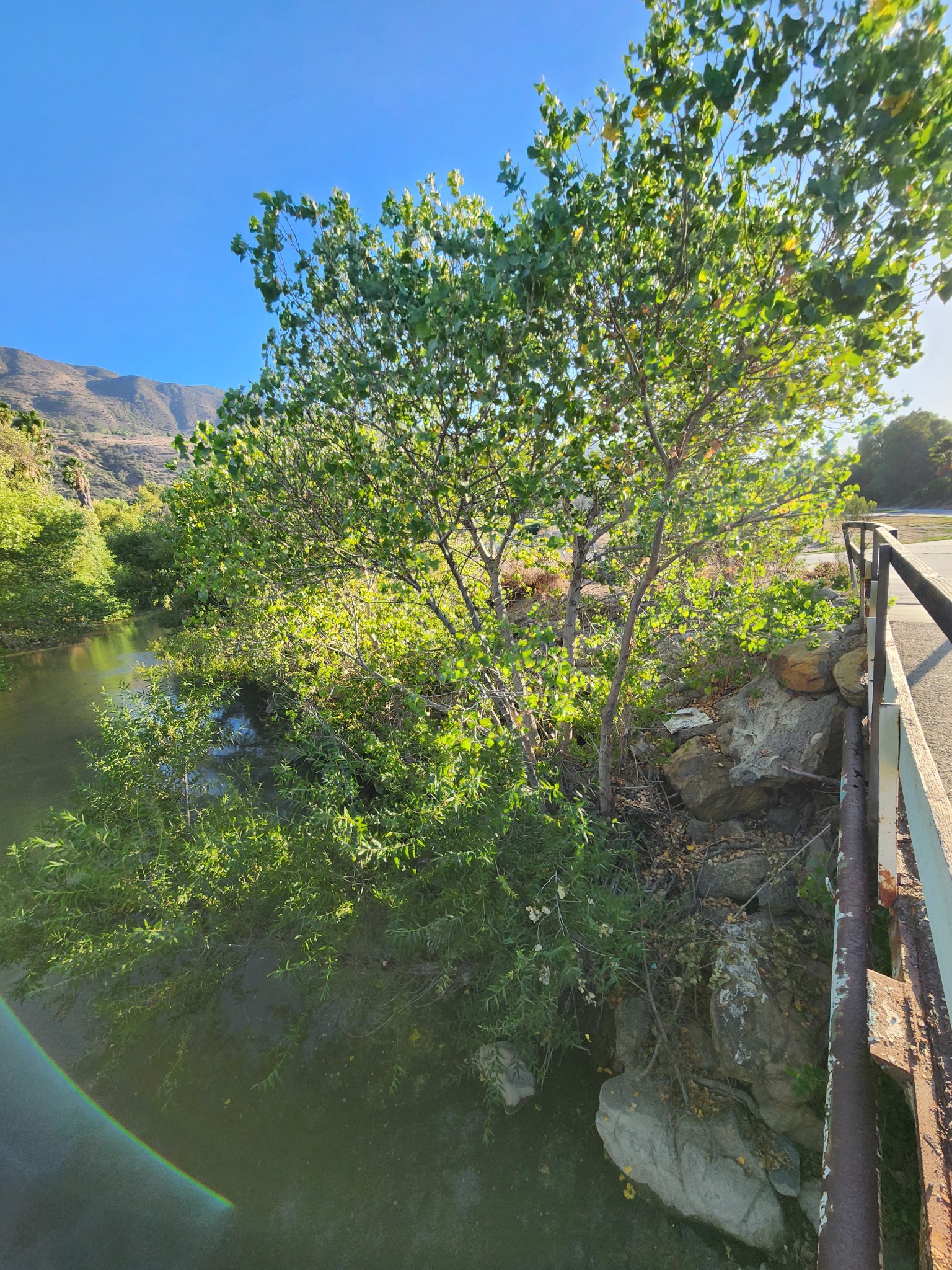
The Newcomer grows at the farthest point of our daily walk, beside the footbridge near the railroad tracks. The bridge serves as our usual turnaround point, making this tree both the end of one journey and the beginning of the walk home.
She is also the only tree in the group growing directly from the riverbank. While the first three cottonwoods receive supplemental irrigation and the Sentinel’s water source remains hidden, the Newcomer grows immediately beside the Santa Ana River. Her position appears to give her roots direct access to river water and saturated soil.
 © Lindsey Thome
At least five comparatively slender trunks emerge from her base. There may be a sixth, although a willow growing beneath the cottonwood obscures the point where it begins, making it difficult to determine whether it is another trunk or a large branch. Her position on the steep bank also prevents me from safely measuring her circumference.
Her location presents one disadvantage for measurement but an advantage for observation. Because the tree grows downslope from the footbridge, portions of her canopy rise near eye level. Leaves that would ordinarily be suspended well above me are close enough to examine individually.
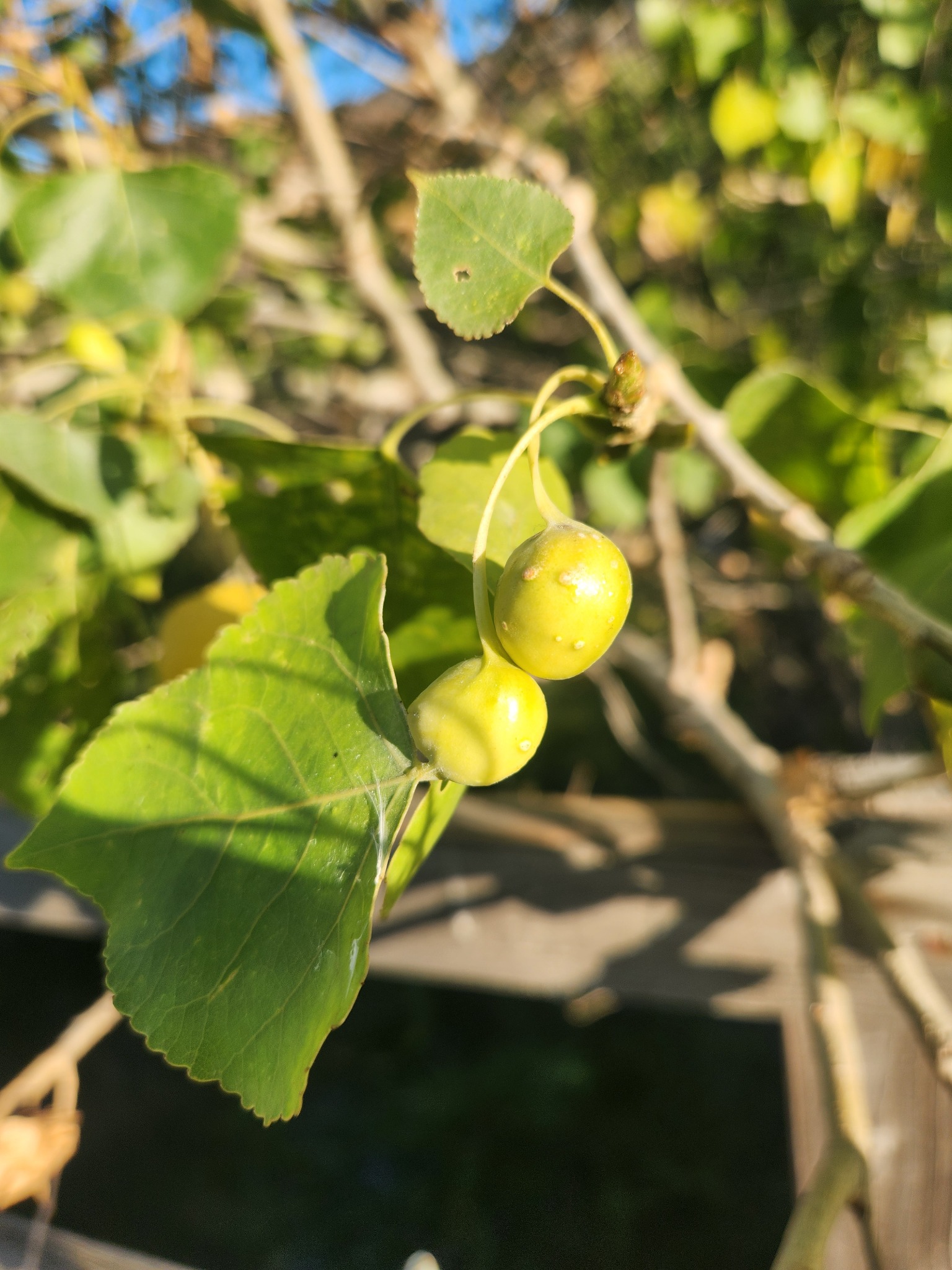
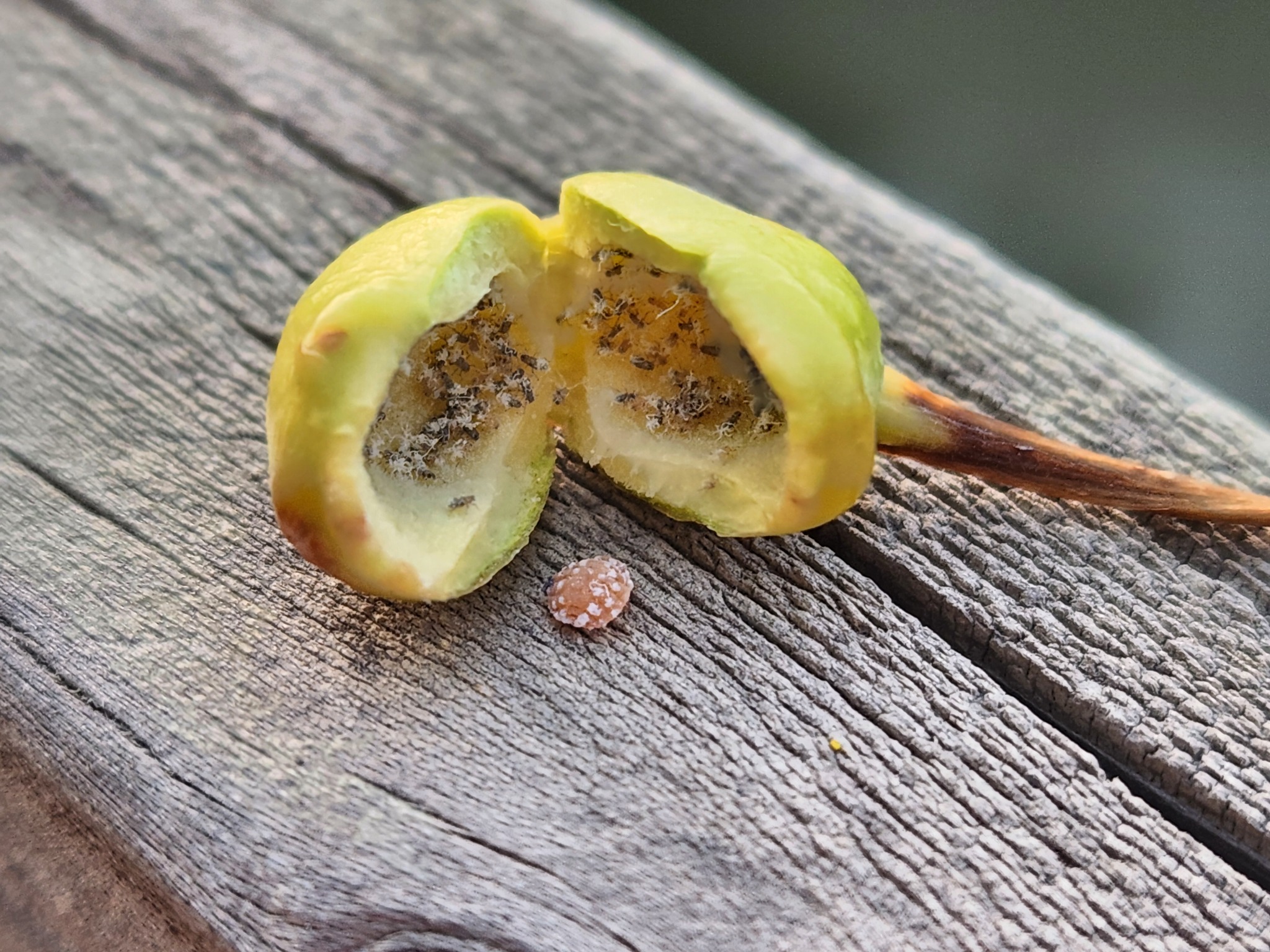
Many of those leaves bear conspicuous galls consistent with the work of poplar petiole gall aphids. Each gall begins when aphid activity causes plant tissue to swell around the leaf stem, creating a protected chamber in which aphids can feed and reproduce. Although the growths can look alarming, they are generally considered primarily cosmetic and seldom cause serious lasting harm to an otherwise healthy tree.
 © Lindsey Thome
 © Lindsey Thome
From the bridge, the Newcomer’s petiole galls are close enough to examine intact and opened. Inside the swollen plant tissue, aphids feed and reproduce in a protected chamber.
The Newcomer also occupies one of the most visibly urban positions in the series. She appears to grow from a narrow opening in the concrete armoring along the riverbank, either through a crack or between two concrete blocks. Willow branches crowd her base, trains pass nearby, and pedestrians cross above her. Yet her canopy supports bushtits, goldfinches, and other small birds, while the galls shelter lives almost too small to see.
I chose the Newcomer because she represents continuation. The older trees bear cavities, deadwood, decomposing limbs, and other records of long lives. This tree is still assembling her architecture, extending several young trunks upward from an unlikely foothold beside the river. She shows that the cottonwood stand is not only aging and releasing old wood. It is also renewing itself. Multiple trunks can also mean resprouting from an older root system, so “newcomer” is a working hypothesis as much as a name. It is one more question to carry forward.
At the fall equinox, most of the Newcomer’s canopy remained bright green, with fewer than ten percent of the leaves turning golden yellow across much of the tree. At the top of the crown, however, the transition was much more pronounced. Approximately forty percent of the visible leaves had turned yellow or gold.
I cannot make the same comparison with the other cottonwoods because their upper crowns are difficult to inspect from the ground. The Newcomer grows below the footbridge, placing more of her canopy within view. Her crown may be changing earlier than those of the other trees, or the same pattern may be occurring beyond my sight in their highest branches. For now, the difference is an observation rather than an explanation. It is a question to carry into the next season.
The petiole galls also remained conspicuous across much of the accessible foliage, providing another baseline for comparison after the leaves fall and new growth emerges in spring.
Issue 1 at a glance
The five trees, side by side
| Tree | Form | Circumference | Est. height | Water | Sex |
|---|---|---|---|---|---|
| The Greeter | Single trunk | 149 in | ≈55 ft | Irrigated field | ? |
| The Commons | Four trunks, mounded base | 105 in, 1 of 4 | ≈42 ft | Consistently irrigated | ? |
| Ole Miss | Single trunk | 104.5 in | ≈45 ft | Green’s sprinklers | ? |
| The Sentinel | Single trunk | 163 in | ≈65 ft | Possibly groundwater | ? |
| The Newcomer | Five or more slender trunks | Not measurable | ≈35 ft | Riverbank | ? |
Seasonal log: canopy condition
| Tree | Fall Equinox 2026 | Winter | Spring | Summer | Fall 2027 |
|---|---|---|---|---|---|
| The Greeter | Under 10% yellow; no leaf galls | — | — | — | — |
| The Commons | Under 10% yellow; heavy leaf and bark litter at base | — | — | — | — |
| Ole Miss | Under 10% gold; mistletoe olive green; dead limb in crown | — | — | — | — |
| The Sentinel | Under 10% gold; crown mostly green | — | — | — | — |
| The Newcomer | Under 10% yellow overall; about 40% at crown; galls widespread | — | — | — | — |